|
CCINW News, Newsletters and Tips
 Newsletters Newsletters
> September 2010 [pdf]
Calendar, Cleaning College, Featured Member, Connections
> Fall 2010 [pdf]
Calendar, Cleaning College, RIA, Dues & Refunds, Featured Member,
Connections
> August 2010 [pdf]
Calendar, Connections, Social Networking for Customers, Advocates Program
> December 2009 [pdf]
Calendar, New Benefit for Monthly Dues, Facebook, Membership Renewals
> November 2009 [pdf]
CCINW Thanksgiving, Facebook, Membership Renewals
> October 2009 [pdf]
Photos from CCINW at Cleaners Supply Warehouse Customer Appreciation Day,
IICRC Board Meeting,
IICRC S100 Standard for Peer Review, Calendar
> September 2009 [pdf]
Photos from Connections 2009 - Las Vegas, New Member Corner, New Board Members,
Calendar
> August 2009 [pdf]
New Management Team, What Do You Know? New Member Corner, Calendar
CCINW Photo Caption Contest Make CCINW Laugh!
[August 2, 2013]
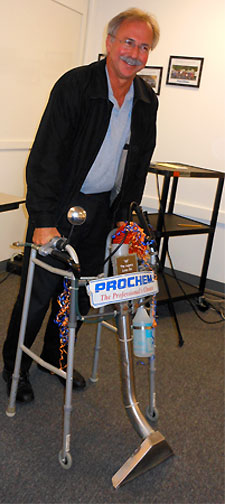
What's going on? CCINW needs your originality and wit to describe this
gentleman and situation as originally as possible. Prose, poetry, as one
word or a word play - simply create a fun caption for the photo above.
Make us laugh! Get this: The winner of the contest could win ... hearty
laughs from your CCINW colleagues!
Writing funny commentary? What could be better? The best caption will be
chosen and displayed here. Email your brilliance to Jane at
info@ccinw.org.
CCINW, Connections, and The Experience
[August 2, 2013] You may or may not know that "Connections
Conference and Trade Show" has been retired as of 2012.
"The Experience
Convention & Trade Show" has been created as a possible option should you
decide to attend a convention this year.
>
Check out the agenda
CCINW is not participating as an association. The IICRCA has created a
convention and tradeshow debuting the Spring of 2014. CCINW will be
participating as an association. It should be amazing. Stay tuned for details.
Building the Council of Associations – IICRCA!
The International Inspection, Cleaning and Restoration Council of Associations
by Bryan O'Haleck
[March 19, 2013] If you’ve been part of the CCINW for any length
of time, you know we’ve been leaders in trying to get organizations in the
cleaning and restoration industry to work together. We started Connections, we
partnered with ASCR and CFI, and we’re associated with World FloorCovering to
provide better benefits to CCINW members. Today we’re looking toward helping the
IICRC build an umbrella organization, the Council of Associations –
IICRCA.
The following is an excerpt from information provided by the CCINW
representative to the IICRC, and interim IICRCA President, Tony Wheelwright.
One of the primary purposes of the IICRCA is supporting the affiliated
organizations.
Why is this part of the plan?
● Our current IICRC shareholder associations could better serve their members by
having a benevolent umbrella group to provide services and benefits, while also
helping them become more current.
● Franchise organizations that have been strong advocates of industry education
have asked if the IICRCA would allow them to join and have a place where they
can share information.
● Trade associations that represent multiple facets of the total cleaning
industry have asked if the IICRCA would allow them to join and also have a place
to share information.
● Industry organization and industry suppliers would be able to work together on
projects and resolve scheduling and other conflicts.
Industry organizations are already collaborating, and many have signed
Memorandums of Understanding (MOUs) to continue this trend. The
IICRCA will
simply speed up the process and do it in an organized fashion, while allowing
the affiliated organizations to maintain their own history and identity.
Together, this council of associations can be a far more effective machine for
promoting all of our interests to each other, the public, facilities managers,
government agencies, insurers and manufacturers.
The Council of Associations can help in more ways than collaboration. By sharing
resources, the group as a whole can reduce overhead costs and be able to access
legal, marketing and research services that the individual organizations could
not afford alone. Our agenda might seem ambitious, but the potential for the
industries we serve is great.
Can you imagine a single place where manufacturers can get feedback from people
that see their products years after the sale? Where restoration contractors can
talk to rug specialists about handling wet, sooty rugs? Where organizations can
collaborate on overlapping projects?
By being committed to being a trustworthy and inclusive organization, the
IICRCA
can be that place.
Contact IICRCA headquarters to learn more about the IICRCA at
IICRCA.org
CCINW Blast from the Past!

by
Jane O'Haleck
[August 2012]
It is so fun to see where the CCINW has been. Do you know who these
industry people are? Top far right is Tom Hill and lower row
second from the left is Kenway Mead. Who else do you recognize?
Tune to the CCINW Channel for 2012!
 by
Jane O'Haleck by
Jane O'Haleck
We have a full year of meetings and conventions on the docket in
2012, so stay tuned to the “CCINW Channel” for schedules and
other news with the Carpet Cleaners Institute of the Northwest.
Find us on
Facebook and
Twitter.
[January 2012]
2011 was a year of gaining ground and strengthening foundations.
As you know, the IICRC has embraced a more descriptive marketing
name, choosing “The Clean Trust” as one that will mean
something to consumers. Shareholders (like the CCINW) are
working on the ground level moving the organization forward. You
may be surprised by some of the announcements that will be made
over the coming year. If you want to be a part of what will be
remembered as a historic period in our industry, you can get
involved through your membership in the CCINW.
Find us at:
ccinw.org or
facebook as CCINW or
Twitter as CarpetCleanNW
Dealing with a Down Economy? Ways to Stack the Odds in Your Favor!
 by
Jane O'Haleck by
Jane O'Haleck
[July 2011]
Except for a short blip right after 9/11, companies established
after the early 1980s have never had to deal with a “down”
economy. What have we learned?
• Off days can turn into off months, is there enough cash
reserved?
• Throw out what you knew about marketing
• Competition becomes fierce
• Fierce competition leads customers to become more price
focused
• Experimenting until something works is no longer affordable
This is when association with trusted members of your trade
becomes even more important. Comparing notes about what’s
working for other similar operations can be fastest way to
overcoming business development issues. The CCINW is committed
to assisting our members navigating and thriving in this new
world of business.
On that note… summer meetings are pretty rare, but this August
we have a chance to hear from Miles Austin again. He’s so
excited about what can be done with QR codes that he can’t wait
to share it with us. Those fortunate enough to attend Miles’
seminars on web tools came away with slump-busting strategies,
so this might be a meeting to plan your vacation around.
Business attorney and strategist Loren Joner spoke to our group
in May about how to handle the life cycle of a business. Loren
suggested that every business needed to be a “limited
partnership” with the owner establishing a relationship with an
accountant, attorney, insurance specialist, and a retirement
planner.
No matter where your business is between start-up and your
retirement, there are ways to stack the odds in your favor and
asking for referrals to find trusted advisors is one of the
best.
Find us at:
ccinw.org or
facebook as CCINW or
Twitter as CarpetCleanNW
Longtime CCINW Member Wins Prestigious Restoration Award
Canstar Executive Wins RIA’s Martin L. King Award
 Colorado Springs, CO;
2010 – The Restoration Industry Association (RIA),
presented its highest individual industry honor, the Martin L.
King Award, to Art Johnson, CR, WLS, at its recent annual
Convention & Exhibition in Colorado Springs, Colo. Johnson is
the operations manager for Canstar Restorations in Vancouver,
B.C., and the first Canadian to win the honor. Colorado Springs, CO;
2010 – The Restoration Industry Association (RIA),
presented its highest individual industry honor, the Martin L.
King Award, to Art Johnson, CR, WLS, at its recent annual
Convention & Exhibition in Colorado Springs, Colo. Johnson is
the operations manager for Canstar Restorations in Vancouver,
B.C., and the first Canadian to win the honor.
Given annually, the Martin L. King Award recognizes an
individual’s exceptional service and dedication to the
restoration industry. Johnson was honored for his many years of
service to RIA, serving as the chairman of the Water Loss
Institute, co-chairman of the Restoration Council, and chairman
of the Environmental Council. He currently sits on RIA’s Board
of Directors.
“I am humbled and honored by this award,” said Johnson. “This
organization and industry are my life. I was just trying to do
my job to the best of my ability.”
Congratulations, Art Johnson!
Cleaning College Roundup
 CCINW Cleaning College Roundup: Thank you! CCINW Cleaning College Roundup: Thank you!
The CCINW held a
Cleaning College this October, the first in over fifteen years. The idea was
to bring needed information to our members that might not be covered in typical
industry courses. The seminars chosen for this year were:
Web tools and social media marketing; New and easy
color repair techniques;
Blood-borne pathogen training for carpet cleaners and restorers; and
Rug ID for cleaning. Two courses sold out and all gained rave reviews from
those that attended. The most gratifying comments were ones heard from several
people in each seminar: We didn’t pay enough to get this much information!
We’ll do this again whenever we identify a member need, so
contact the CCINW
office if there is a topic of interest to you.
Thanks to the students for making the CCINW Cleaning College a rousing success,
and a special thanks to all of those that donated their time and effort to the
cause:
Luke, Linda and the staff at
Interlink Supply
Instructors Miles Austin, Tony Wheelwright, Patrick Paluga, Thea Sand and Bryan
O’Haleck
Jane O’Haleck, for keeping it all together.
A very special thank you goes to Dusty Roberts for donating a
RugBadger
portable rug duster as a raffle prize. A $10 ticket can win a $3,800
machine, and only 100 tickets will be sold.
> Cleaning College 2010 Information
CCINW Team Colors
 Join
Team CCINW and proudly wear our team colors! Our
Palm Trees
Hawaiian print shirts (#408) are embroidered with “CCINW 2010”. All yours
for $35. Contact us to order
> See large
image Join
Team CCINW and proudly wear our team colors! Our
Palm Trees
Hawaiian print shirts (#408) are embroidered with “CCINW 2010”. All yours
for $35. Contact us to order
> See large
image
Federal Lead-Based Paint Law
 The
new Federal Lead Based Paint Laws take effect on April 22, 2010. A new pollution
policy is being released that will respond to the strict liability imposed upon
contractors performing work on Pre-1978 residential properties. This will be a
nationwide product with an AM BEST Rated A (Excellent), X carrier. A stand alone
policy will be available with a minimum premium starting at $250. Instant online
quotes and binding will be offered and the carrier expects to have the lowest
rates and minimum premium for a pollution policy of this type. The
new Federal Lead Based Paint Laws take effect on April 22, 2010. A new pollution
policy is being released that will respond to the strict liability imposed upon
contractors performing work on Pre-1978 residential properties. This will be a
nationwide product with an AM BEST Rated A (Excellent), X carrier. A stand alone
policy will be available with a minimum premium starting at $250. Instant online
quotes and binding will be offered and the carrier expects to have the lowest
rates and minimum premium for a pollution policy of this type.
This is a Federal law that will affect contractors nationwide. Each State may
have different requirements and may address the issue differently. In Oregon,
many contractors will choose to obtain the “Certified Lead-Based Paint
Renovation (LBPR) Contractors License”. Most residential paint, remodeling, and
renovation contractors will need the new CCB license. Contractors choosing not
to obtain the new LBPR license should cease all renovation and painting work on
older homes and other buildings known as “target housing” and “child-occupied
facilities” in Oregon (effective April 22, 2010) until they obtain an Oregon CCB
LBPR license.
CCINW member Al Ochosa, Senior Account Executive for Oak Tree Insurance wants to
remind restoration and remediation professionals that beginning April 2010,
federal law will require contractors that disturb lead-based paint in homes,
child care facilities and schools, built before 1978 to be certified and follow
specific work practices to prevent lead contamination.
Ochosa says, "Cleaners that do any sort of structural drying, or disturb areas
with lead-based paint, in older buildings and homes may be affected as well.
There will now be a product to address this liability. Lead or lead particles
are standard exclusions in many of the Commercial General Liability policies, as
well as Contractors Pollution Liability policies, available in the marketplace.
As far as I know, there is no other product available that addresses this issue.
Currently, the carrier is scrambling to get this released prior to the April 22
deadline."
> Read the
Federal Lead-Based Paint Law [pdf; 79 pages]
> Read Renovate Right: Important Lead Hazard Information for Families, Child
Care Providers [pdf; 19 pages]
CCINW Oregon Cleans Ronald McDonald House in Portland

[April 2010] For the past ten years, the CCINW Oregon region members have organized to
support the Ronald McDonald House Charities,
a group that provides accommodations to the families of seriously ill children
during hospital care. As a part of this support, members get together to provide
no-cost cleaning at the two Houses in Portland. The 2010 season’s group cleaning
was
Friday,
April 9th. We thank the members that participated in this event, as they
not only get personal satisfaction from helping a worthy cause, they show CCINW
members to be a little more special than the average cleaning company.
For the 2010 effort, Dri-Eaz and
Sapphire Scientific
donated a gallon of cleaning products and traffic lane cleaner for every member
that participates in this event. Dri-Eaz also hosted the meal
afterwards. We want to thank Dri-Eaz and
Sapphire Scientific
for their history of supporting the CCINW, and special thanks for rewarding our
members for “doing a good thing.”
> Details in
Flyer
Dust mask respirators N-95 Rules
[March, 2007] You've seen the dust masks before; the N-95s that are common on
lots of jobsites. Well, did you know that OSHA considers single-use dust masks,
like the N-95s, to be air-purifying respirators (APRs). OSHA refers to these
dust masks as "filtering facepieces" and defines them as negative pressure
particulate respirators:
· With a filter that is an integral part of the facepiece, or
· With the entire facepiece composed of the filter medium
These masks must be NIOSH-certified to be acceptable by OSHA as respirators
under the standard. Look on the packaging (or on the dust mask) for the NIOSH
mark.
Voluntary use
Medical evaluations, fit tests, and in-depth care training are not required for
workers who voluntarily wear dust masks. However, OSHA does require that you
receive the information contained in Appendix D of the Respiratory Protection
standard.
How about mandatory use?
Because OSHA considers NIOSH-approved disposable dust masks to be air-purifying
respirators, medical evaluations and fit testing are required prior to wearing
mandatory-use dust mask respirators.
OSHA's medical requirements for wearing a respirator in the workplace are the
same whether the respirator is a mandatory-use dust mask or a SCBA. In the
Respiratory Protection standard at 1910.134(e)(2), OSHA requires that a medical
evaluation using a medical questionnaire or an initial medical examination that
obtains the same information as the medical questionnaire be used. The medical
evaluation must cover, at a minimum, the information requested in Appendix C of
the standard, Sections 1 and 2 of Part A.
Fit testing disposable respirators
In a letter dated March 4, 1996, OSHA explains that either a quantitative (QNFT)
fit test or a qualitative (QLFT) fit test is an acceptable method to fit test an
N-95 disposable respirator. A quantitative fit test is acceptable, provided the
test is conducted according to the recommendations of the respirator
manufacturer. Also, a fit factor of 100 should be used when conducting a
quantitative fit test.
The generally accepted assigned protection factor (APF) is 10 for disposable
respirators. When a quantitative fit test is conducted, the wearer of the mask
is assigned a fit factor that is based upon the APF plus a safety factor of 10.
The combination of the APF and the safety factor is the derivation of the fit
factor (100).
OSHA also requires that wearers of respirators conduct a fit check each and
every time they don a respirator. The fit check may be conducted according to
the manufacturer�s instructions. Some respirator manufacturers provide fit test
kits for disposable respirators. Your employer may want to contact the
manufacturer of your respirators for a fit test kit.
What you need to do for voluntary-use tight-fitting respirators
Tight-fitting (elastomeric) respirators may be worn on a voluntary basis. If you
use them, your employer must:
· Provide the information in Appendix D of the Respiratory Protection standard;
· Provide a medical evaluation;
· Provide training on procedures for cleaning, disinfecting, storing, repairing,
removing from service or discarding, and otherwise maintaining respirators; and
· Set up schedules for these elements, according to the regulation.
|
|